
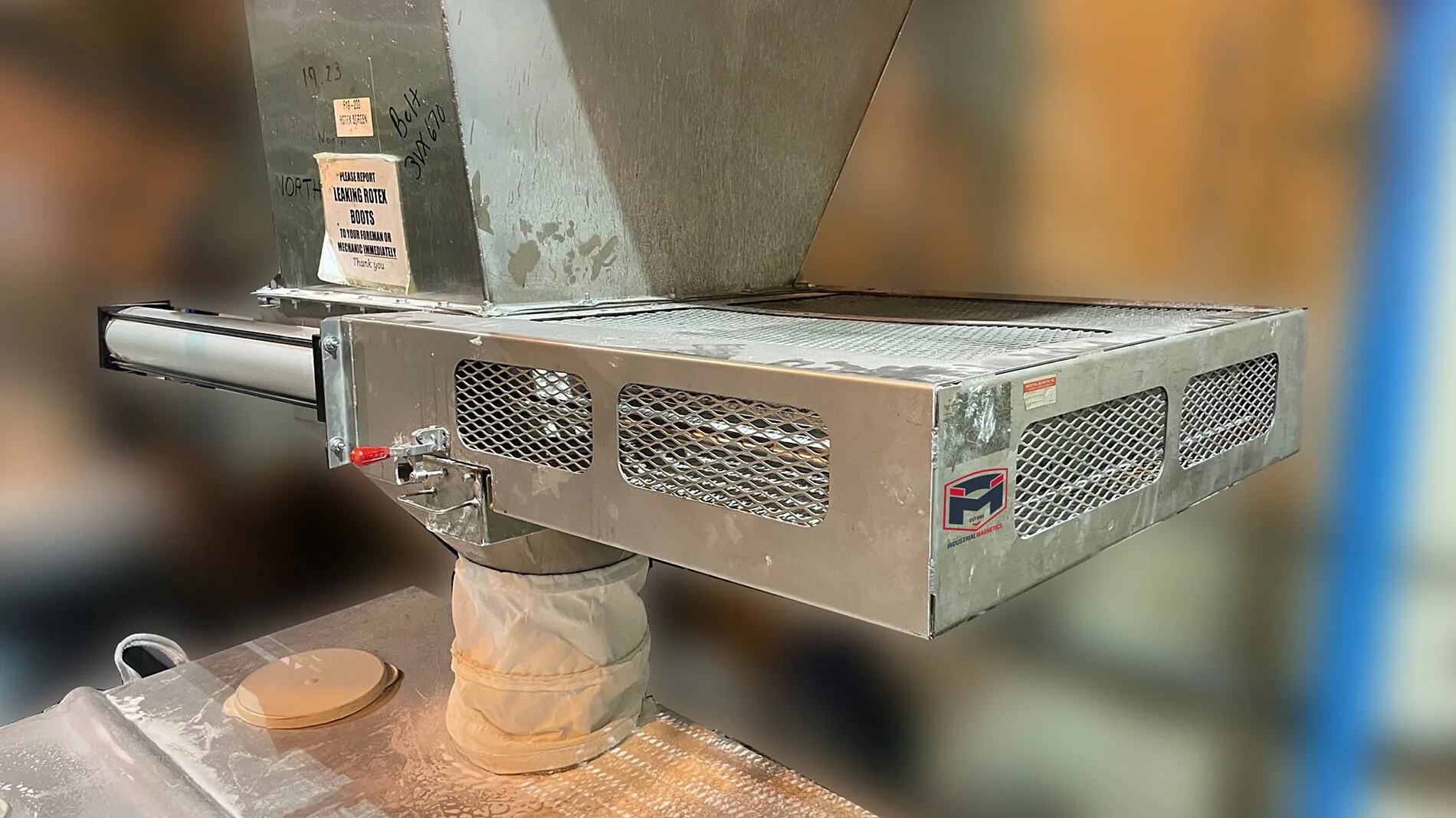
When ferrous metal contamination threatens your product quality, your process efficiency, or your downstream equipment, the right magnetic separator makes all the difference. For operations that rely on chutes, hoppers, or vertical product flow, several gravity-feed solutions are purpose-built to protect your product stream — but they’re not interchangeable.
The three most common options for gravity-feed applications are the Extractor, the Split-Flow Magnet, and the Drawer-in-Housing. Each is engineered for a distinct set of conditions. Choosing the right one starts with understanding how each works, what it does well, and where it fits in the real world.
How Gravity-Feed Magnetic Separation Works
Unlike belt-conveyed or pneumatically conveyed products, gravity-feed applications rely on the natural fall of material through chutes, spouts, or vertical housings. This free-falling or channeled flow creates a unique separation environment: contact time between the product and the magnet is short, velocities can vary, and flow density can range from loose and aerated to dense and choked.
The best gravity-feed separators account for these conditions using magnet geometry, housing design, and field intensity to maximize ferrous capture regardless of how the material behaves in motion.
The Extractor: A Proven Solution for Larger Tramp Metal
The Extractor is a reliable workhorse for one specific job: capturing larger tramp metal in light-duty tramp metal applications. As material enters through the inlet, a built-in diverter angles the product stream toward the magnetic field. Ferrous contaminants are captured and held against the magnet face while clean product continues through.
Standard models include an EZ-Clean stripper drawer for quick, straightforward metal removal without shutting down the line. An air-actuated self-cleaning unit is also available for automated or remote cleaning.
The Extractor is the right tool when:
- You’re dealing with larger tramp metal — not fine ferrous particles
- Product flow is relatively consistent and free-flowing
- The application is light-duty and doesn’t require the separation performance of a tube-based design
- Installation constraints favor a simpler housing format
Important note: For applications where finer ferrous separation is needed, or where separation efficiency is the priority, a Drawer-in-Housing will typically outperform the Extractor. The Extractor remains a viable option, but it’s designed for a narrower set of use cases.
Common applications: Aggregate, some plastics, general manufacturing environments with coarser tramp metal contamination
The Split-Flow Magnet: Built for Dense or Choked Flow
The Split-Flow Magnet is engineered for a specific challenge: dense or choked material flow through vertical chutes where a single magnetic contact point isn’t enough.
As product enters the Split-Flow housing, a center wedge magnet physically splits the flow into two streams, diverting both toward a pair of extra high-intensity parallel magnets. The result is three magnetic contact points — the center wedge plus two parallel magnets — providing maximum attraction and holding power across the full product stream.
This multi-point design is what makes the Split-Flow effective in choke-flow conditions, where dense or sluggish material doesn’t naturally spread across a single magnet face. The housing is constructed of all-welded stainless steel and is available in both EZ-Clean and Self-Cleaning configurations.
The Split-Flow is the right tool when:
- Product flows in dense, heavy, or choked conditions through vertical chutes
- Free-falling product velocity requires multiple contact points for reliable capture
- Stainless steel construction is required for sanitary or corrosive environments
- Extra-high intensity magnets are needed
Common industries: Pharmaceutical, food and feed, plastics, mineral processing
The Drawer-in-Housing: The Preferred Choice for Most Gravity-Feed Applications
For the majority of gravity-feed magnetic separation needs, the Drawer-in-Housing (DIH) — also known as a Drawer Magnet or Grate-in-Housing — delivers superior separation performance. It’s the solution IMI most commonly recommends when a customer is evaluating gravity-feed options.
The DIH consists of rows of round magnetic tubes assembled into drawers inside a housing. The tubes of each row are aligned on alternating centers from the row above or below, so as product flows into the top of the housing, it cascades in a zig-zag pattern from row to row over the magnetic tubes. This ensures maximum tramp metal capture because the product comes into direct and repeated contact with a magnet as it travels through — not just once, but multiple times.
IMI offers the Drawer-in-Housing in a wide range of configurations for different application demands:
- Standard Rectangular DIH — for most dry processing systems
- Round DIH — ideal for low-profile applications and in-stream use with dry, free-flowing powders and granular products
- Large Tube Housing (LTH®) — incorporates 3” diameter rare earth tubes for difficult-flowing products; achieves 28 lbs. of pull value on a 1/2” ball, the highest value of any 3” circuit on the market
- Mid-Tube Housing (MTH™) — 2” diameter rare earth tubes for optimum separation in high-flow rate applications
- Ox® Heavy Duty DIH — engineered for challenging separation conditions
- RotoDrawer™ — a rotary style DIH for products that have difficult flow characteristics and a tendency to bridge or choke
Sanitary Grade Drawer-in-Housing Magnets are USDA AMS accepted for Dairy, Meat and Poultry processing equipment, and select models carry HACCP International certification.
The Drawer-in-Housing is the right tool when:
- You need the highest level of ferrous metal capture in a gravity-feed application
- Product is dry and free-flowing to moderately dense, with specialized configurations for difficult-flowing or choke-prone materials
- Regulatory compliance (USDA, HACCP) or sanitary construction is required
- You want the flexibility of multiple tube configurations to match your exact product and flow conditions
Common industries: Food, feed and grain, pharmaceutical, plastics, chemical processing, mineral processing
Side-by-Side Comparison
The Questions That Drive the Right Decision
The best separator for your application depends on what your process actually demands. These are the questions that most often guide the recommendation:
What contaminants are you trying to capture? Larger tramp metal — a broken bolt or worn tooling fragment — is a different problem than fine ferrous particles or weakly magnetic fines. If your primary concern is coarser tramp metal in a light-duty application, the Extractor may be appropriate. If you need thorough ferrous separation across a range of particle sizes, the DIH is almost always the stronger performer.
What does your flow look like? Dense, choked, or sluggish material in a vertical chute is where the Split-Flow earns its place. Free-flowing powders, granules, and processed materials are typically best served by a DIH — with tube size and configuration matched to flow characteristics.
What are your regulatory or sanitary requirements? If you’re operating in food, dairy, meat and poultry, or pharmaceutical environments, sanitary construction and compliance certifications matter. IMI’s Sanitary Grade DIH line is purpose-built for those environments.
What does your installation allow? Housing footprint, inlet/outlet orientation, chute dimensions, and available headroom all factor into which configuration can be properly installed and positioned for optimal performance.
Talk to an Expert Before You Spec
Magnetic separation is rarely one-size-fits-all, and getting it right the first time means fewer contamination events, less unplanned downtime, and cleaner product from day one.
IMI’s team works directly with engineers and operations leaders to evaluate your specific application conditions and recommend the separator configuration that will perform. Whether you’re protecting food-grade product from fine ferrous particles or guarding downstream equipment from larger tramp metal, we can help you find the right fit. Contact an IMI separation specialist